





Animal Damage
Bacterial Disease
Environmental Damage
Fungal Disease
Herbicide Injury
Insect Damage
Diseases:

| Hardiness Zone: |
5 - 9
[Find Your Zone] |
| Mature Height: | 0 Feet |
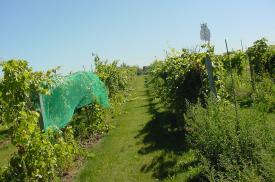
| Culture: | Grapes can be grown in the backyard, but trellises will be needed to support them. American varieties are hardier and more suited for table use than European types. Grapes require severe annual pruning early each spring to remain productive. Grapes flower and produce fruit only on one-year-old canes. The most productive wood is on the 6 to 8 buds closest to the base of the cane. Canes with moderate vigor and about the diameter of a pencil are most productive. So pruning is needed to encourage new canes to develop, eliminate unproductive canes, train fruiting canes, and limit the number of buds on the vine. When done properly, pruning often removes 80 to 90 percent of the wood. Pruning is suggested after the coldest part of winter but before buds swell. February and early March are good times. Various training systems can be followed when pruning, with the Four-Cane Kniffin one of the more popular. This system ends up with a central trunk and four one-year-old lateral canes, or arms, supported by trellis wires. Each arm has 6 to 12 buds, for a total of 35 or more buds on the entire plant. Each bud produces two or three clusters of grapes. Two renewal spurs are left at each trellis wire for future fruiting canes. All other growth essentially is removed each year to leave this framework. |
| Cultivars: | There are various types of grapes: European types, American types, muscadine (grown mainly in the southern states of US), and French hybrids. Grapes are utilized as table grapes, wine grapes, raisins, and for making jelly. Table and juice grape varieties: Alden, Alwood, Beta, Blueball, Buffalo, Caco, Concord, Edelweiss, Festivee, Fredonia, Moored, New York Muscat, Ontario, Price, St. Croix, Schulyer, Seneca, Sheridan, Stueben, Swenson Red, Urbana, Valiant, Van Buren, Vinered, Worden, and Yates. Seedless table grapes: Canadice, Challenger, Concord seedless, Glenora, Himrod, Interlaken, Lakemont, Mars, Einset, Reliance, Remaily, Romulus, Saturn, Suffolk Red, Vanessa, and Venus. Wine grape varieties: Catawba, Cayuga White, Delaware, diamond, Dutchess, Elvira, Horizon, Isabella, Ives, Melody, Niagara, Veeblanc, Ventura, Chambourcin, Chancellor, De Chaunac, Leon Millot, Marechal Foch, Rosette, Rougeon, and Seyval. |
| Mature Form: | |
| Native To: | |
| Soil Conditions: |
Dry
 Moist, Well-Drained Wet
|
| Tolerance: |
Alkaline Soil
Dry Sites
Salt
Soil Compaction
Wet Sites
Wind
|
| Uses: |
Massing
Patio
Screen
Shade
Specimen
Street
Wind Break
|
| Foliage Color: | |
| Fall Foliage Color: | |
| Additional Notes: | Rootstocks are widely used in grape production. Rootstocks that are commonly used are tolerant or resistant to phylloxera and nematode attack. Some rootstocks may be selected because they can tolerate too high soil pH while others can tolerate drought. |


